On Writing: Where a Life Meets the Work
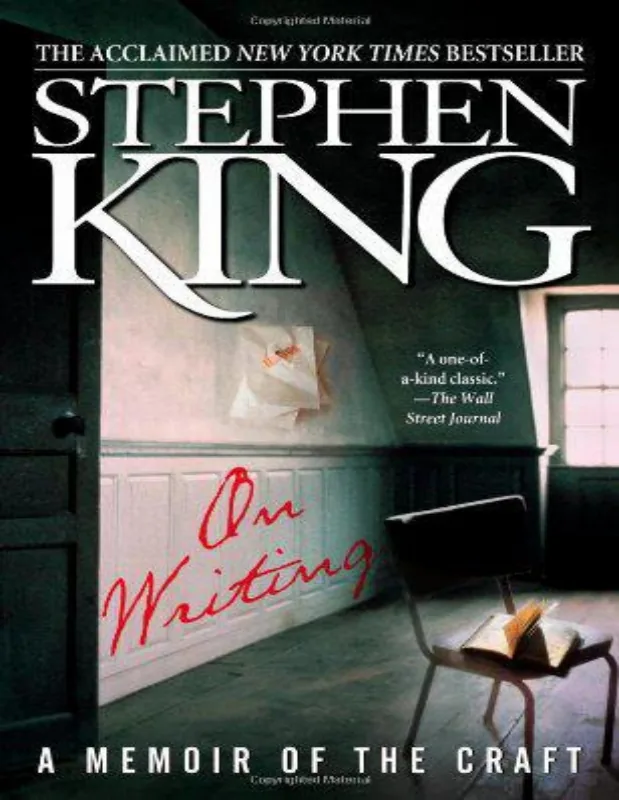
On Writing: A Memoir of the Craft · By Stephen King
A writing life grows from lived experience, ordinary tools, steady reading, regular work, honest revision, and an eventual reader.
- Publisher
- Scribner
- Publication year
- 2000
- ISBN
- 9780743211536
About this book
- First published
- 2000 · Scribner
- Form
- Memoir and practical writing guide
- Original language
- English
- Structure
- Three forewords, five main sections and two ‘And Furthermore’ appendices
- Central concerns
- Language, reading, routine, story discovery, revision and recovery
Why it matters
On Writing refuses to separate technique from the conditions in which technique is learned. King’s memoir makes rejection, paid work, family support, addiction, injury, and recovery part of the craft’s history; the instructional sections then move from ordinary language tools to reading, routine, discovery, description, and revision. The result is neither a neutral textbook nor a universal method. It endures because it shows a working writer testing strong preferences against lived consequences, then opening the draft toward a reader.
Recognition & reach
- Winner, Nonfiction category, 2000 Bram Stoker Awards (presented in 2001).
- Selected for TIME’s 2011 All-TIME 100 Nonfiction Books list.
- On the 2020 edition page, Scribner describes On Writing as a million-copy bestseller.
Sources
5-minute overview
Ten reading nodes, from the three forewords and C.V. to the toolbox, the open door, recovery, and the final booklist
Core thesis
On Writing binds memoir to instruction so the advice never floats free of the life that produced it. The C.V. shows practice, rejection, work, family, addiction, and recovery; What Writing Is and Toolbox reduce craft to a transfer between minds built from ordinary words, grammar, sentences, and paragraphs. On Writing then turns those tools into a routine of reading, drafting, discovery, description, character, and revision. It is not a universal system: King’s preference for situation over plot and his numerical habits are personal working methods, not laws for every form. The deeper pattern is portable: make the first draft privately, gain distance, reopen the door to an ideal reader, and revise toward clearer shared experience.
The book at a glance
- 01
Before the advice: motive, limits, and a writer’s formation
Three short forewords establish why King is writing, why he values brevity, and where an editor enters; the long C.V. then shows the lived conditions behind the counsel.
- 02
Writing as transmission and tool use
The book first imagines writing as a signal reconstructed by another mind, then opens a toolbox of language units that can make that signal clearer.
- 03
Daily practice meets story and life
The central section moves from reading and routine to situation, character, description, theme, feedback, and revision; the postscript returns those practices to an injured body and a changed life.
- 04
The open door: revision and continued reading
Two appendices replace abstract advice with a marked-up story opening and a personal reading record, ending the book with work still in progress.
Show the full contents (10 chapters)Hide the full contents
Before the advice: motive, limits, and a writer’s formation
- 01
First Foreword
Amy Tan’s observation that writers are rarely asked about language gives King a reason to discuss the work rather than merely his success.
- 02
Second Foreword
A promise of brevity limits the book’s authority and rejects the idea that writers fully understand why every piece succeeds or fails.
- 03
Third Foreword
A compact joke about editorial authority introduces revision as a negotiation rather than unquestioning obedience.
- 04
C.V.
Snapshots of childhood, reading, rejection, paid work, family, publication, addiction, and recovery trace how one writer’s habits and material took shape.
Writing as transmission and tool use
- 05
What Writing Is
A scene shared across distance becomes a playful model of how selected details invite a reader to complete an act of imagination.
- 06
Toolbox
Vocabulary, grammar, sentences, and paragraphs are arranged as ordinary working tools whose value comes from clarity and practiced control.
Daily practice meets story and life
- 07
On Writing
Reading and regular work create the conditions for stories to emerge, while distance and an ideal reader help a private draft become public prose.
- 08
On Living: A Postscript
The 1999 accident, treatment, and return to the desk show writing as one possible route back into attention and daily life, not a substitute for care.
The open door: revision and continued reading
- 09
And Furthermore, Part I: Door Shut, Door Open
A raw and revised opening from ‘1408’ exposes cuts, additions, moved information, and the reader-facing choices behind a second draft.
- 10
And Furthermore, Part II: A Booklist
A personal list of recent reading turns the command to read widely into evidence while refusing to present one writer’s taste as a canon.
Twenty-three lines from motive and tools to revision, recovery, and reading
Table of contents
Before the toolbox, there is a laundry. Before the rules about adverbs and paragraphs, there are rejection slips on a nail, work done after exhausting shifts, a family deciding what it can afford, and a writer learning that talent does not remove the need to sit down again tomorrow. On Writing spends a surprising amount of time in those rooms because its advice is never meant to arrive from nowhere.
This reading follows that design without turning it into a seven-step system. It begins with the life that gives the advice its accent, then moves through transmission, tools, routine, story discovery, revision, and the return to work after serious injury. King’s habits are vivid and sometimes emphatic. They are most useful when treated as one practitioner’s tested preferences—material to question against your own language, genre, body, obligations, and draft.
Why does a craft book begin in the laundry room?
The three forewords are small, but each removes a possible disguise. In the first, Amy Tan’s remark that nobody asks popular novelists about language gives King permission to discuss the work itself. In the second, he distrusts the inflated authority of writing manuals and promises to be brief. In the third, he acknowledges the editor whose decisions helped produce the book now claiming to teach craft. Motive, limit, collaboration: the lesson starts before the lesson announces itself.
Then the C.V. refuses the smooth line of a professional origin story. Its episodes arrive as snapshots: childhood imitation, the first story written without copying, submissions and rejections, small payments, newspaper editing, factory and laundry work, marriage, children, success, addiction, intervention, and recovery. The sequence does not prove that hardship makes art. It shows something more useful: a writing practice is built inside material conditions, and those conditions keep leaving marks on what a writer notices.
That distinction matters when the book later speaks with confidence about rooms, schedules, and output. The confidence belongs to a particular life. A caregiver working in fragments, a poet revising one page for a month, and a novelist drafting before dawn do not fail because they cannot reproduce King’s day. The transferable question is smaller and more demanding: what repeatable arrangement lets this life make contact with the work?
The C.V. also complicates the romance of innate talent. King is skeptical that writers can simply be manufactured, yet he also says common storytelling ability can be strengthened. The useful space lies between those claims. No course can guarantee a career; neither does “talent” excuse a writer from reading, practice, feedback, or revision. Formation is not manufacture. It is what happens when capacity meets time, tools, attention, luck, and other people.
Source note: “First Foreword,” “Second Foreword,” “Third Foreword,” and “C.V.” The account of material conditions and the distinction between formation and manufacture are this site’s synthesis of those sections, not a framework named by King.
What survives the journey from one mind to another?
Imagine a table covered with a red cloth, a cage, and a white rabbit marked with a blue 8. The writer supplies a few signals; the reader builds the room. “What Writing Is” calls this telepathy, with enough playfulness to keep the metaphor from becoming a scientific claim. The point is not paranormal transfer. It is that marks made at one desk can cause a scene to be reconstructed by someone elsewhere, years later, without the writer present to correct it.
This shifts the standard for clarity. A draft cannot export the complete picture in its author’s head. It can only select what another mind needs in order to begin. Too little detail leaves no object for attention; too much detail replaces a scene with an inventory. The work is to find the charged particulars—the elements that establish relation, expectation, or unease—and trust the reader to bring memory and imagination to the rest.
That trust is not vagueness. It is designed participation. If several readers all miss the same turn, the signal may be weak or misdirected. If they picture different wallpaper while feeling the same pressure in the room, the prose may be doing exactly enough. Feedback becomes more useful when it asks what a reader saw, expected, and failed to connect instead of merely whether the reader “got it.”
The metaphor quietly predicts the rest of the book. Vocabulary and grammar shape the signal. Routine keeps producing it. Description decides what to transmit. Revision removes interference. The ideal reader tests whether a private image can become shared experience.
Source note: “What Writing Is,” especially the thought experiment that joins writer and reader across time and place. Treating telepathy as a model of signal and reconstruction, rather than a factual supernatural claim, is this site’s interpretation.
Why does the toolbox begin with ordinary words?
The toolbox was made by King’s grandfather and inherited by his uncle, but its lesson is not nostalgia. A worker facing an uncertain repair carries the full box because an unexpected problem can require a tool left elsewhere—and that is how discouragement enters. For a writer, the upper trays hold vocabulary and grammar; sentences and paragraphs turn those pieces into movement.
The most bracing advice is also the least glamorous: use the vocabulary you have. Reading will enlarge it, but dressing a sentence in words chosen to look educated usually makes both the writer and the prose self-conscious. Precision is not the same as rarity. The best word is the one that performs the action, establishes the relation, or carries the voice without asking the reader to admire its price tag.
King’s attacks on passive constructions and adverbs come from the same suspicion. Fear makes a writer hedge, explain, and bolt emotional labels onto dialogue that should already reveal its temperature. That diagnosis is more portable than a ban. Passive voice can be exact when the actor is unknown or deliberately backgrounded; an adverb can alter meaning rather than repeat it. The revision question is not “Is this form forbidden?” but “What uncertainty is this word trying to hide?”
Paragraphs make the toolbox visible on the page. Their length changes speed before a sentence is even read; a break redirects attention, grants air, or withholds it. A paragraph is therefore both semantic and physical—a map of what the writer believes belongs together. Read a page from across the room and its shape will already tell you something about pressure, pause, and invitation.
Tools matter because they reduce friction between intention and effect. They do not standardize voice. A writer can be plain or baroque, formal or conversational, so long as the choice is active and the prose can bear its weight.
Source note: “Toolbox,” including its three-level toolbox metaphor and its discussions of vocabulary, grammar, sentences, paragraphs, passive constructions, and adverbs. The exceptions and diagnostic questions here are this site’s adaptation, not additional rules stated by King.
What turns good intentions into pages?
A room with a closed door is not magical. Its value is repetition: arrive, reduce competing signals, begin. In “On Writing,” the practical foundation is blunt—read a lot and write a lot. Reading supplies rhythm, possibility, and examples of failure; writing forces those judgments into sentences where they can be tested. Neither activity graduates into the other. They keep correcting each other.
King’s own schedule is memorable enough to become a trap for readers. A daily numerical target can protect momentum, but his target is evidence about his process, not a moral unit. For another writer, the repeatable minimum may be a timed session, one revised exchange, or returning to the document before the gap becomes intimidating. A quota earns its place only if it helps the next day begin.
The same is true of the writing room. A dedicated office is useful because it lowers the cost of re-entry, not because a desk makes someone serious. A pair of headphones, a recurring train ride, or a document opened at the same hour can perform the same cue. The essential boundary is attentional: during the first draft, do not make every uncertain fact, incoming message, or imagined judgment an excuse to leave the story.
Research deserves special suspicion here. Necessary facts can deepen a scene, but they can also become a socially respectable form of avoidance. Mark the gap, keep moving, and return later unless the missing fact changes the action itself. Stable practice is not the production of daily brilliance. It is the creation of enough material for judgment to work on during revision.
Source note: The opening numbered parts of “On Writing” on reading, regular writing, workspace, closed-door drafting, and daily rhythm, together with the later discussion of research as back story. The variable minimum and placeholder tactic are this site’s practical adaptation.
If plot loosens its grip, what makes a story move?
King’s fossil is one of the book’s most durable images. A story is not assembled from a blueprint so much as uncovered from a situation; the writer’s job is to remove it without breaking more than necessary. He distrusts plot when it becomes a jackhammer—loud, efficient, and capable of destroying the delicate structure it is meant to free.
The replacement for control is not randomness. It is pressure. Put people with wants, fears, habits, and partial knowledge into a predicament, then take their choices seriously. A situation creates constraints; character creates action; action changes the situation. Causality remains, but it is discovered through consequence rather than imposed to satisfy an outline drawn before the people inside it could resist.
That is a powerful method for the kind of fiction King writes, and it is still a method, not a law of narrative. A mystery may require advance architecture; a historical novel may depend on fixed events; a screenwriter may need to coordinate production before discovery has finished. An outline can be a hypothesis rather than a prison. The relevant test is whether it responds when characters and consequences reveal something truer than the plan.
Description follows the same principle of selective pressure. The writer sees more than the reader needs. A few details establish locale and texture, then the reader’s own experience completes the scene. Dialogue and action reveal character by forcing choices under pressure; theme becomes visible after patterns recur, not because every scene was ordered to recite a message.
This is why “write what you know” is too small if it means copying autobiography and too large if it licenses anything without observation. King’s broader move is to write what you care about, then give it life with specific knowledge of work, relationship, fear, and desire. The invented surface earns trust from the felt truth underneath it.
Source note: “On Writing,” especially the numbered discussions of subject, truth in fiction, story versus plot, situation, character, description, dialogue, symbolism, and theme. The outline-as-hypothesis framing and cross-form limits are this site’s editorial boundary.
When should the door open?
The first draft needs privacy because premature explanation makes a writer hear objections before the story has a voice. Privacy, however, is a stage—not a claim that readers do not matter. Once the draft exists, King recommends distance. Time away lets the writer return less as the person who remembers every intention and more as someone encountering what is actually on the page.
Then the door opens. King imagines an ideal reader, for him Tabitha, whose pleasure and resistance matter enough to sharpen his attention without becoming a referendum. The useful reader is not automatically the kindest or the most credentialed. It is the person whose response helps distinguish deliberate difficulty from accidental confusion, a slow burn from a dead passage, and surprise from missing information.
Revision begins above the sentence. Where does the story truly start? Which choice changes the situation? What setup never pays off, and what late object arrives without preparation? Only after those questions should the draft spend hours polishing lines that may not survive. The percentage formula King received on a rejection slip—second draft equals first draft minus ten percent—is best read as pressure toward compression, not a mechanical acceptance test. Some drafts need to grow before they can tighten.
Read in sequence, the closed door, the cooling period, the ideal reader, and the top-down revision form a four-step improvement cycle that repeats rather than resolves. King does not number the stages; the ordering is this site’s synthesis of how the chapters follow one another.
“Door Shut, Door Open” makes the work inspectable. The marked and revised opening of “1408” cuts repeated inference and stage direction, introduces a necessary prop earlier, changes a cumbersome name, and keeps an adverb when it performs a specific social action. The value is not that every cut is universal. It is that each change can answer a reader-facing question.
Opening the door does not erase the author. It changes the author’s responsibility—from protecting an emerging draft to making a finished experience legible to someone who was not there when it began.
Source note: The later parts of “On Writing” on cooling the draft, the ideal reader, feedback, revision, and the ten-percent formula, plus “And Furthermore, Part I: Door Shut, Door Open.” The order of structural and sentence-level questions is this site’s editorial synthesis.
What does the work return to after the accident?
“On Living” puts the body back into every earlier instruction. The 1999 collision, surgery, pain, dependence, rehabilitation, and eventual return to the desk make routine look different from the way it did when routine was merely advice. Beginning again is not a triumph of productivity over injury. It is a fragile act performed inside treatment, care, altered capacity, and time.
That boundary matters. King writes that writing can sometimes be a way back to life; he does not establish writing as medicine, nor does he make output the measure of recovery. A person who cannot work while ill, grieving, or traumatized has not failed a test of seriousness. Protecting the body and accepting help may be the work that preserves all later work.
The postscript also changes the meaning of happiness. The point is not fame, money, or a heroic daily streak. It is the possibility that making something can enrich the reader’s life and the writer’s own. The claim is modest enough to survive a bad session: a page need not justify a career today; it can simply restore contact with attention, language, and another person.
The two “And Furthermore” sections keep that contact practical. The first exposes revision rather than hiding mastery behind a clean page. The second offers a booklist while insisting it is personal, not canonical. Reading never becomes a prerequisite that can be completed. It remains part of the writing life—a record of other minds continuing to enter the room.
Bring the book back to one page
Choose one page of your own draft. First, mark the detail that carries the scene from your mind into the reader’s; if none does, add one precise signal. Next, circle the choice that changes the situation; if events only arrive, give a character something consequential to do. Finally, read the page as your ideal reader might and make one cut, one clarification, or one earned addition. These are editorial stops derived from this reading, not exercises prescribed by Stephen King. One honest change is enough to reopen the door.
Source note: The discussion above draws on “On Living: A Postscript” and both “And Furthermore” parts. The closing exercise also combines “What Writing Is” with the “On Writing” discussions of situation, the ideal reader, and revision. The health boundary, the reading-list-as-footprint interpretation, and the exercise are this site’s synthesis; they should not be read as medical advice, a ranking, or an exercise claimed by King.