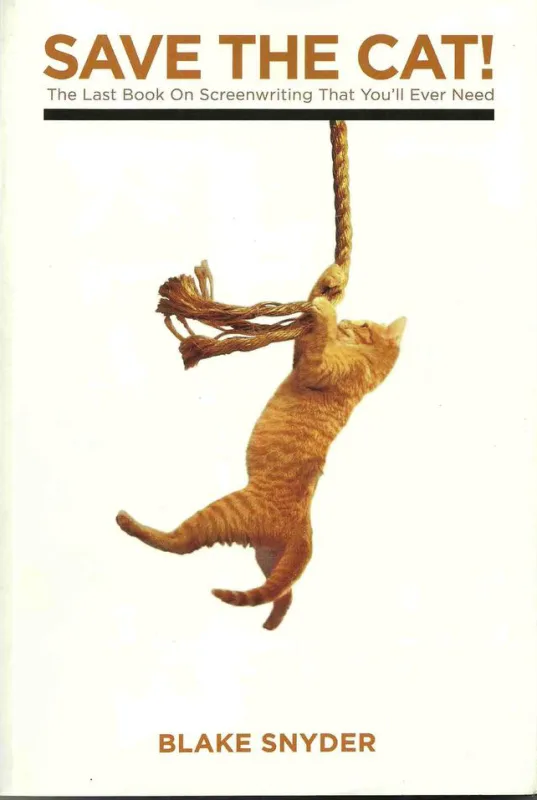
Save the Cat!, Beat by Beat: How an Idea Becomes a Structure
Save the Cat!: The Last Book on Screenwriting You'll Ever Need · By Blake Snyder
Structure begins before page one: if the idea cannot be said in a sentence and placed on a page-count curve, no amount of good scenes will hold it together.
- Publisher
- Michael Wiese Productions
- Publication year
- 2005
- ISBN
- 9781932907001
About this book
- First published
- 2005 · Michael Wiese Productions
- Structure
- Eight chapters, plus a foreword, an introduction and a glossary
- Signature framework
- The Blake Snyder Beat Sheet — fifteen beats on a single page
- Subject
- Screenwriting: idea, genre, hero, structure, script repair and marketing
- Best for
- Writers who have a premise and cannot get it to hold together as a draft
Why it matters
Save the Cat! came out of Snyder's working life as a spec screenwriter rather than from a classroom, and it reads that way: informal, market-conscious, and organised around problems writers actually bring to a draft. Its lasting contribution is the Blake Snyder Beat Sheet, a one-page form of fifteen named beats with page positions, which gave a generation of writers a shared vocabulary for talking about where a story turns. That same specificity is why it draws criticism — positions offered as proportions are easily read as a formula, and the book's own examples skew heavily to mainstream American film of its period.
Sources
5-minute overview
Eight chapters that move from a one-sentence idea to a finished script, and one page that has outlasted the rest of the book
Core thesis
Save the Cat! argues that most screenplays fail before they are written, because the idea was never tested. Snyder's sequence runs idea first, then genre, then hero, then structure: a logline that promises conflict and an audience, a familiar story type that tells you what viewers already expect, a hero chosen to make that promise sharper, and only then the fifteen beats of the Blake Snyder Beat Sheet, laid out as proportions of a roughly 110-page script. The later chapters turn the same logic on a finished draft, asking what is wrong when everything is technically present but nothing pulls.
The book at a glance
- 01
Eight chapters, from a sentence to a sale
The book runs one continuous argument with no part divisions: get the idea right, place it in a type, cast a hero who sharpens it, beat out the structure, build it physically, obey a handful of hard-won rules, repair what breaks, and only then take it to market.
Show the full contents (8 chapters)Hide the full contents
Eight chapters, from a sentence to a sale
- 01
What Is It?
Before craft, salability: what a logline must contain to make a listener want the movie, and why an idea that cannot be told in a sentence is not yet ready to write.
- 02
Give Me the Same Thing… Only Different!
Proposes ten story types every film can be sorted into, so a writer can see what audiences already expect from this kind of story and where a fresh turn is still available.
- 03
It's About a Guy Who…
Moves the focus from premise to protagonist, arguing the hero should be adjusted to serve the idea rather than the reverse, and that the logline is the constant both must answer to.
- 04
Let's Beat It Out!
Introduces the Blake Snyder Beat Sheet: fifteen named beats with page positions for a roughly 110-page script, presented as one page a writer fills in before drafting, then demonstrated on a complete film.
- 05
Building the Perfect Beast
Turns the beat sheet into something physical — a board of four rows and forty cards — so that pacing problems become visible as gaps and overloads rather than vague unease.
- 06
The Immutable Laws of Screenplay Physics
A set of named rules drawn from experience, including the one the book is titled after and the Covenant of the Arc, each explaining a specific way scripts lose an audience.
- 07
What's Wrong with This Picture?
Diagnostics for a finished draft that does not work: passive heroes, dialogue that narrates the plot, antagonists too weak to force change, and a closing checklist of questions.
- 08
Final Fade In
Leaves the page for the market — how to approach the industry, what to avoid, and why long-term positioning matters more than any single sale.
Lines worth returning to
Table of contents
Most advice about structure arrives too late. You have a premise you believe in, you have written forty or sixty pages, and something is wrong in a way that resists description — the scenes work individually, the dialogue is fine, and yet the thing will not pull. The usual response is to hunt for the broken scene.
Snyder's response is to look further back, at the idea itself, and ask whether it was ever tested. That reordering is what makes this book useful even to writers who dislike its confidence: it treats a great many drafting problems as premise problems that only became visible on page sixty.
The sentence your script has to survive
Before craft, before structure, the book asks a commercial question: can you say what this is, in a sentence, to someone with no reason to care? Snyder treats failure here as disqualifying rather than as a marketing inconvenience. If the idea cannot be told, the argument goes, it has not yet been understood.
He asks that sentence to carry two things beyond mere description. The first is irony — a contradiction built into the situation, the holidaying cop who walks into a siege — and its absence is read as a sign that the premise has no engine. The second is a picture: a listener should be able to see scenes you have not written yet. An idea that can only be repeated back in your own words has not opened in anyone else's head.
What the sentence must name is equally specific: who the hero is, what stands against them, what is at risk. The three-part demand is diagnostic because of what its absence reveals. A premise with no opposition tends to be a situation rather than a story; one with nothing at stake is usually a character sketch. Either can absorb sixty pages before the gap becomes visible.
The book then makes the logline permanent rather than preliminary. It stays on the desk as the constant the draft answers to, so that when a story drifts you have some way of telling whether you are discovering something or losing the thread.
Source note: Chapter 1, "What Is It?", on the logline and its requirements, including irony (page 6) and the demand that a whole film be visible in the sentence (page 7); Chapter 3, "It's About a Guy Who…", on the hero serving the idea and the section "Slave to the Logline" (page 63). Presenting these as a single pre-drafting test is this site's editorial arrangement.
Which raises the question the next chapter exists to answer: once the sentence holds, how do you know what an audience already expects from it?
Same thing, only different
Snyder's answer is to sort every film into one of ten story types of his own naming — the house with a monster in it, the quest for a prize, the ordinary person in extraordinary circumstances, and so on. The categories matter less than the use he puts them to.
The claim is not that these types are a taxonomy of cinema. It is that audiences arrive already knowing them, and therefore already carrying expectations you will either meet or deliberately break. Knowing your type tells you which beats a viewer is waiting for, which means it also tells you where a genuine surprise is still available and where a "surprise" will simply read as the story going wrong.
This is why the chapter insists on breadth of viewing before originality. You cannot tell what is conventional in your kind of story until you have watched enough of that kind — and, he adds, watched backwards through its lineage rather than only across the last few years. Recent films teach you the current surface; the lineage shows which choices were once innovations and which have already hardened into defaults.
Source note: Chapter 2, "Give Me the Same Thing… Only Different!", on the ten story types and on the depth of film knowledge the method assumes (page 22). The ten type names are Snyder's own. The framing of genre as a map of audience expectation rather than a classification scheme is this site's reading.
Fifteen beats on a single page
The best-known part of the book is a form. Snyder's beat sheet is one page he fills in before drafting, on the principle that a beat you cannot describe in a sentence or two is a beat you have not worked out.
The fifteen beats, with the page positions as printed:
| # | Beat | Page |
|---|---|---|
| 1 | Opening Image | 1 |
| 2 | Theme Stated | 5 |
| 3 | Set-up | 1–10 |
| 4 | Catalyst | 12 |
| 5 | Debate | 12–25 |
| 6 | Break into Two | 25 |
| 7 | B Story | 30 |
| 8 | Fun and Games | 30–55 |
| 9 | Midpoint | 55 |
| 10 | Bad Guys Close In | 55–75 |
| 11 | All Is Lost | 75 |
| 12 | Dark Night of the Soul | 75–85 |
| 13 | Break into Three | 85 |
| 14 | Finale | 85–110 |
| 15 | Final Image | 110 |
The page numbers are the part most often quoted and most often misread. Snyder attaches them to a script of roughly 110 pages and says plainly that longer dramas keep the same proportions — so these are ratios expressed in the units he worked in, not marks a script must hit. Read as proportions, the sheet describes a rate of change: how long a story may spend deciding before it commits, how far in the ground should shift, how late the lowest point can fall and still leave room to climb out.
Read as page numbers, it becomes the formula its critics object to. The qualification is in the book; the reputation for rigidity comes largely from readers who kept the table and dropped the sentence that follows it.
Two beats repay attention because they are structural rather than incidental. The opening image is asked to do contract work — establishing tone and scope before any plot arrives — and is deliberately paired with the final image so the two form a before-and-after of the same world. And the theme, stated early and usually by someone other than the hero, exists because Snyder thinks a screenplay is an argument: a proposition about how to live, which the rest of the film tests. That is a stronger claim than it first appears, and it explains why he wants the proposition on the table by page five.
Source note: Chapter 4, "Let's Beat It Out!". The beat names and page positions are reproduced from the beat sheet form as printed on page 70; the author's own statement that these are proportions of a roughly 110-page script, and hold for longer dramas, appears on page 71. "Fun and Games" is noted there as his own name for that beat. The opening/final image pairing and the screenplay-as-argument claim are on pages 72–73. The chapter then works the full sheet through one film in detail (pages 92–95).
A form, though, is still a list. The next chapter asks what happens when you have to lay it out in space.
Making it physical
Snyder's answer is a board: four rows, one per act-section, and forty index cards. The constraint is the point. Forty cards is fewer than most writers expect, and the shortage forces decisions about what actually belongs.
What the board provides is not organisation but exposure. A scene that felt enormous while you imagined it becomes one card among forty, and the sequence you assumed would carry twenty minutes turns out to be three cards with a gap after them. Problems that are hard to feel while reading — an overloaded first act, a third act that keeps thinning — become visible as physical distribution.
He also fixes an order of work: the hinge points go up first, and the connecting material fills in afterwards. Structure before texture, which is the same priority the beat sheet encodes.
Source note: Chapter 5, "Building the Perfect Beast", on the board and the forty-card limit, the deflationary effect of seeing scenes laid out (page 104), and the instruction to place the major turns first (page 105).
Why the antagonist is the one who doesn't change
Chapter 6 collects rules Snyder names after the situations that produced them. One deserves isolating, because it is regularly quoted in a truncated form that inverts its meaning.
The Covenant of the Arc holds that every character must change over the course of the story — and then immediately excepts the antagonist. The exception carries the actual idea. Change is not a quality to be distributed evenly across a cast; refusal to change is what distinguishes the opposition. A villain who learns becomes something else, and a supporting cast that stays fixed while the hero moves will read as scenery.
A second rule from the same chapter is more mundane and more frequently useful: a threat only works if the audience has been shown what it would cost. Danger that has been described but never demonstrated produces no tension, which is the quiet explanation for a great many second acts that feel slack despite a genuinely dangerous premise.
Source note: Chapter 6, "The Immutable Laws of Screenplay Physics", on the Covenant of the Arc and its stated exception for antagonists, and on present versus reported danger (both page 134). Reading that exception as characterisation rather than omission is this site's interpretation.
When the draft is finished and still doesn't work
The last working chapter turns the method on a completed script, and its central diagnosis is worth the price of the book for anyone stuck mid-rewrite.
The failure is the passive protagonist. It is hard to spot precisely because everything else can be correct: every beat lands, the plot advances on schedule, the structure is sound. What has gone missing is causation. Events happen in the right order and the lead is present for them without producing any of them. Snyder's fix is stated as law — the hero must be proactive — but it works better as a question asked at each turn: did your lead choose this, or did it merely happen to them?
The chapter closes with a checklist of questions to run against a draft, covering the hero's agency, whether dialogue is narrating plot the scene should be dramatising, and whether the antagonist is strong enough to force change. They are blunt instruments, and they are the sort of blunt instrument that finds problems a careful reread will politely skip.
Asked of every draft rather than reserved for the one that has stalled, the same questions become a repeatable revision loop instead of a rescue — which is the only form in which a diagnostic tool keeps earning its place.
Source note: Chapter 7, "What's Wrong with This Picture?", on the inactive hero and the stated law that the hero must be proactive (page 145), and the closing "Is It Broken?" question set (pages 160–161).
Where the method stops
The book's limits follow from its origins, and it is fairer to name them than to pretend the method is universal.
It was written by a working spec screenwriter for the American studio market of the early 2000s, and it optimises for that market: ideas that can be pitched, structures that read fast, films that promise a recognisable experience. The final chapter, on approaching agents and building a reputation, is the most dated part — its tactics belong to a spec market that has largely closed, even if its point about repeated encounters has aged better.
The deeper limit is one of range. The method assumes a story driven by a protagonist's external goal, and its diagnostics are sharpest on exactly that. Applied to work organised by voice, atmosphere, argument, or an ensemble with no single lead, the fifteen beats will still produce an answer, but the answer may only say that the work is not the kind of thing the sheet describes. A novel whose engine is a narrator's consciousness can fail every beat and be entirely sound.
Used well, then, this is a diagnostic instrument rather than a blueprint. It is unusually good at locating a specific class of problem: a premise that was never tested, a middle with no rising cost, a lead who does not act. Take the sheet to a script that is not working and it will often tell you where. Take it to a script as a set of requirements to satisfy in advance, and you get the formula its critics describe — which the book, read to the end of the paragraph, does not actually ask for.
Source note: Chapter 8, "Final Fade In", on marketing and long-term positioning (page 169). The assessment of the method's range, its dated market advice, and its suitability as diagnosis rather than blueprint are this site's editorial judgments, not claims made by the author.
Reference and edition
- Blake Snyder, Save the Cat!: The Last Book on Screenwriting You'll Ever Need, Michael Wiese Productions, 2005, ISBN
9781932907001(LCCN 2004009134). Citations are by chapter and by the printed page numbers of this edition. - Michael Wiese Productions title page — publisher record for the title.
- Library of Congress record — cataloguing data as printed in the book.
- Open Library edition record — cross-check of edition details.